Planetary science
A body can be broken by collisions.
Fragments can keep a mineral history. Whether 42 Isis is such a fragment is not shown by the orbit, the thermal size, or the two taxonomic letters. No arrow runs from this shore to the other.
Main-belt asteroid
Oxford
23 May 1856
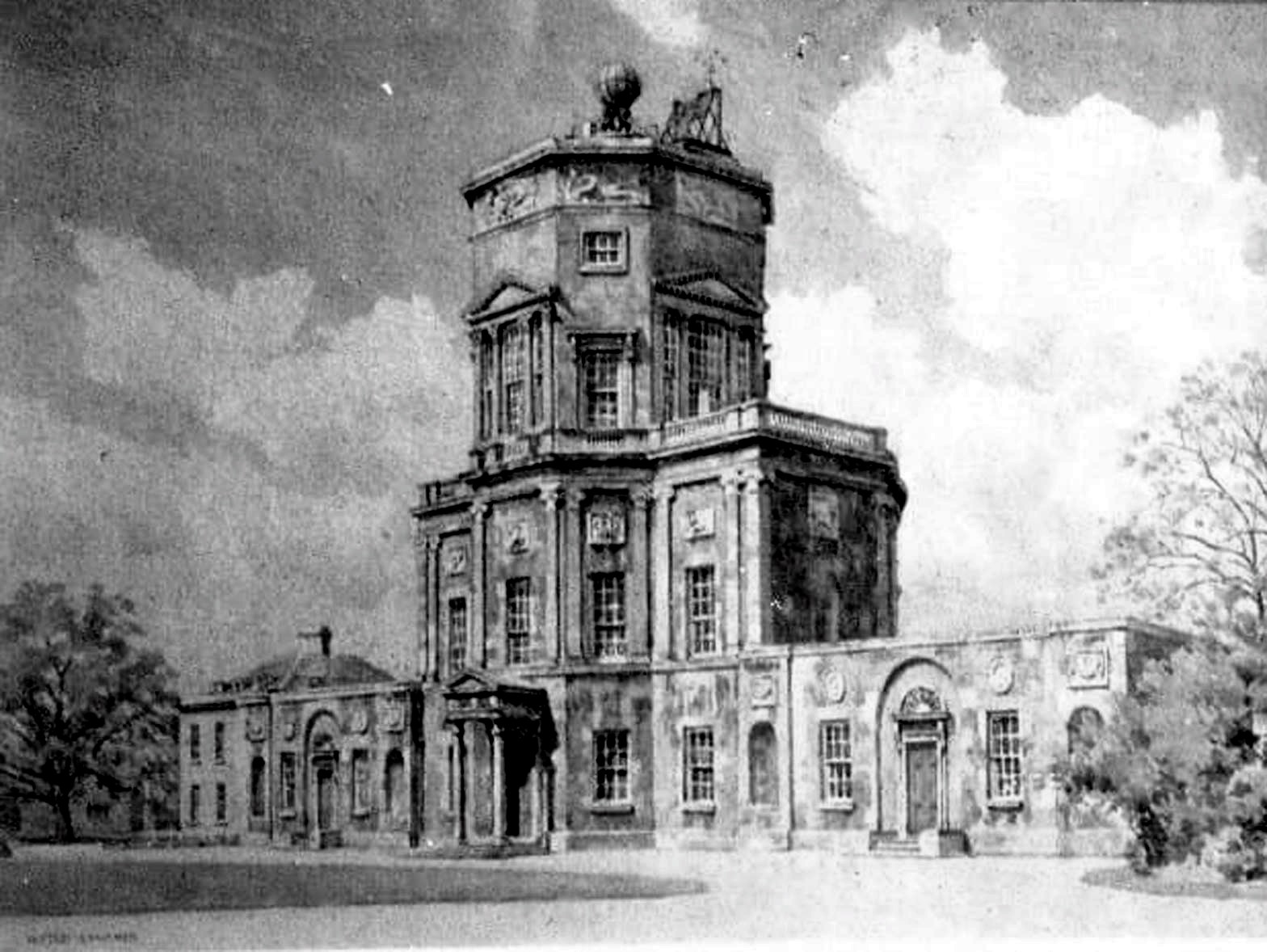
Radcliffe Observatory
Norman Robert Pogson
What can you know about a world you have never seen?

A moving point, written down. The first observation archived by the Minor Planet Center is 20 June 1856. The discovery date and that first archived position are not the same day.
1856A moving point.
2026Still no face.
1.902 au0 days after perihelion. Perihelion. Closest to the Sun.
a is half the long axis. The node lies 84.145° from the equinox direction. Perihelion lies 237.617° from the node, in the direction of motion. The inclination below is drawn to scale. Drag the white path, or run it from perihelion. Mean anomaly at an epoch is not in this drawing. This is not where the body is tonight.
JPL Small-Body Database, solution 2026-06-05. 9006 observations, first archived 20 June 1856, last 2026-04-07. Condition code 0.
111.0 ± 1.4 km
The outline is soft because the shape is not known.
The number is a thermal estimate, not a measured silhouette.
Earth is a little over 12,700 km across. This estimate is roughly one hundred and fifteenth of that. Ceres, 939.4 km in the Dawn result, is about eight and a half times the diameter. Small beside a planet. Not dust.
Diameter and albedo 0.139 ± 0.024: NEOWISE, Mainzer et al., Astrophysical Journal 759 (2012). Ceres: Russell et al., Nature 537 (2016).
13.59 hours
The body rotates. We do not see the surface. We see the light change.
A change can come from rotation, from a shape that is not a sphere, or from a surface that does not reflect evenly. One period does not draw the face. The wave here is the method, not the Harris and Young photometry redrawn.
Rotation 13.59 h from the asteroid lightcurve database, after Harris and Young (1979) and later solutions.
TholenS
SMASSL
The same unresolved light does not return the same letter.
PDS asteroid taxonomy, version 4. Tholen S. SMASS II L. Xu et al. 1995. Bus and Binzel 2002.
Something can be broken and still keep a trace.
What this body keeps, and what it has lost, is not yet a measurement.
42
A catalog number. A place in the order of discovery.
An Egyptian funerary book seats forty-two assessors. That count is real. It is another species of 42. It does not explain this designation.
Oxford
The Thames through Oxford carries this name. Latin Tamesis is older. The story that Thames is Thame plus Isis is false. A temple of Isis in Roman London is a different place and a different century. It does not found the Oxford name.
28 September 1852
A name was set on a body in the sky in 1856. The child who carried it later worked as an astronomer and a meteorologist. In 1886 the Royal Astronomical Society refused her fellowship. The charter’s pronouns were male. She was elected in 1920.
What happens when a name placed in the sky belongs to someone who later studies the sky?
Oxford Dictionary of National Biography, Pogson, (Elizabeth) Isis (1852–1945). The life is the record. It is not a romance added to the rock.
Words cut into stone
The screecher comes, the kite comes: it is Isis and Nephthys. They have come in search of their brother Osiris.
The older witness is a search, spoken by two mourners, not a portrait of a queen. In 1856 those texts were not yet a public English corpus. The Isis in the room at Radcliffe was already the later one.
Planetary science
Fragments can keep a mineral history. Whether 42 Isis is such a fragment is not shown by the orbit, the thermal size, or the two taxonomic letters. No arrow runs from this shore to the other.
What does a fragment carry?
Transmitted myth
Plutarch, in the early second century CE, tells Isis searching, and a body divided into fourteen parts. That is a Greek philosophical retelling. It is not the recitation on Pepi’s wall, and it is not the geology of this asteroid.
A search. Two kites.
Hymns, temples, a goddess whose office widens. Not one frozen story.
The coherent scattering, told in Greek.
A point. A name already full of other histories.
No face.
It never proves interpretation.
42Catalog
IsisName
They met in 1856.



The world did not change. Our model did.
Minor Planet Center. (42) Isis. Oxford, 1856, N. R. Pogson.
JPL Small-Body Database. Solution 2026-06-05. Orbit, absolute magnitude 7.69, condition code 0.
Mainzer, A., et al. NEOWISE. Astrophysical Journal 759 (2012). Diameter 111.0 ± 1.4 km. Albedo 0.139 ± 0.024.
Russell, C. T., et al. Dawn at Ceres. Nature 537 (2016). Diameter 939.4 km.
PDS asteroid taxonomy, version 4. Tholen S. SMASS II L. Xu et al. 1995. Bus and Binzel 2002.
Harris, A. W., and J. W. Young. Lightcurve photometry, 1979, and later solutions gathered in the asteroid lightcurve database. Period 13.59 h.
Schmadel, Lutz D. Dictionary of Minor Planet Names. Naming note: Egyptian Isis, also alluding to Isis Pogson. Does not settle Johnson’s own sentence.
Oxford Dictionary of National Biography. Pogson, (Elizabeth) Isis (1852–1945). Birth, later scientific work, the 1886 refusal, the 1920 election.
Allen, James P. The Ancient Egyptian Pyramid Texts. 2nd ed. Atlanta: SBL Press, 2015. Recitation 535.
Plutarch. De Iside et Osiride. Early second century CE. Used here only as a later Greek witness, not as the Pyramid Texts.
Popular Astronomy 21 (1913). Photograph of Norman Robert Pogson.
Images generated by Grok. The cover, the stone over water, the two birds, and the gathering are interpretations. None is a photograph of the asteroid, and none is a portrait of Aset.